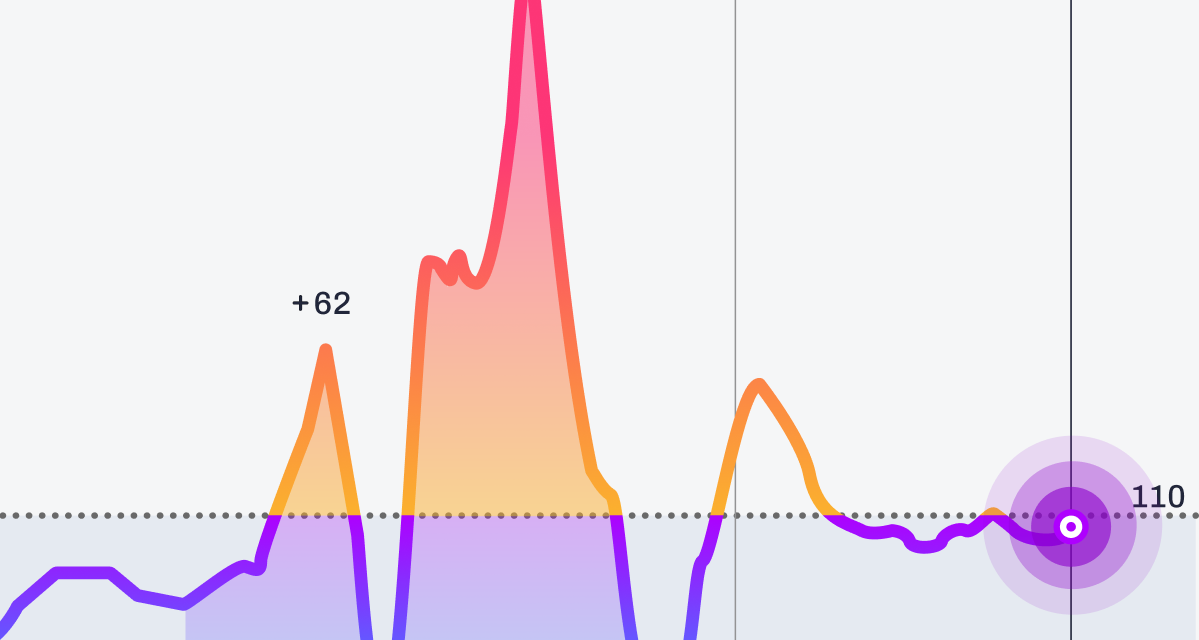


You don't need to eat anything to spike your blood sugar.
That probably goes against everything you've been told about glucose. Because if you Google "things that affect blood sugar," the top results are basically a list of foods to avoid, and a whole lot of finger-pointing at carbs and sugar.
But the truth is, your body is regulating glucose all of the time based on factors that have nothing to do with what’s on your plate. Your nervous system, immune system, hormones, and environment all have a say in your glucose levels. So, if you've ever looked at a CGM and thought, “I haven’t eaten anything. Why is my glucose spiking?” then this is for you.
Here are the 5 unexpected things that could impact your blood sugar without you knowing.
Travel (Specifically, Jet Lag)
When you cross time zones faster than your body's internal clock can adjust, your circadian rhythm gets misaligned. That means your wake/sleep signals and metabolic rhythms all get scrambled. Research shows that circadian disruption impairs both insulin sensitivity and beta cell function (your cells that produce insulin), resulting in impaired glucose tolerance.1
In one study, participants who ate and slept 12 hours out of sync with their normal schedules showed a 6% increase in average glucose and a 22% increase in insulin, meaning their bodies needed way more insulin to manage the same exact meals.2 3 out of 8 participants also crossed into prediabetic territory under this misalignment, despite being completely healthy under their normal conditions.
And you don’t have to fly across the world to experience jet lag. Shift work and “social jet lag,” a mismatch between your weekday and weekend sleep schedule, can also throw your body out of whack. Research found that people with more than an hour of social jet lag have 1.75x the prevalence of diabetes or prediabetes compared to people with less than an hour.3 And about 69% of the population falls into the high social jet lag category.
What to do:
- When traveling, start shifting your sleep schedule a few days before you go
- Get bright morning light as soon as possible in your new time zone to help your internal clock reset faster
- Stay hydrated on the plane
- Try to keep your weekday and weekend bed times within about an hour of each other when you’re not traveling
Sitting Too Long
When was the last time you stood up and moved around? Prolonged sitting, like long flights or long stretches at your desk without moving, can also impact glucose levels. And yes, you can hit your workout target each week and still be affected by this. Research shows that roughly 1 in 4 Americans sit more than 8 hours a day.4
When your muscles contract, they pull glucose out of your bloodstream, which is why even light movement after a meal can help manage any post-meal glucose spikes. Without it, your insulin has to do all the work alone, and the result is higher post-meal glucose (and subsequent insulin) levels.
While standing breaks can offer some benefits compared to sitting, light movement every 30 minutes for just 2-5 minutes (think of these as “exercise snacks”) is the most effective strategy for managing blood glucose.5, 6 If you have to be seated at your desk or on a flight for an extended period of time, seated calf raises have also been shown to improve blood sugar regulation while sitting, specifically after a meal.7
What to do:
- Set a timer to stand up and move every 30 minutes (yes, even a one-minute walk to refill your water bottle counts)
- For long-haul flights or drives, walk the aisle or pull over for a stretching break
- After dinner, it might be tempting to just kick back and watch a show, but even a short 10-minute walk right after a meal can reduce your post-meal glucose response8 (use commercial breaks or credits between episodes as your cue to get up and move around)
Medications and Supplements
If you take a prescription medication or a daily supplement, there's a chance it could affect your glucose, with you even realizing it. This isn't a reason to stop anything (you should always talk to your doctor before making medication changes), but it is worth understanding why your numbers might look different than a friend's, even if you're eating the same meals.
Corticosteroids like prednisone are among the most common culprits, which tell the liver to produce more glucose and make cells less responsive to insulin.9 Long-term or high-dose use can even lead to "steroid-induced diabetes.”10 Older-generation beta-blockers, prescribed for high blood pressure and heart conditions, have been associated with an increased risk of developing type 2 diabetes.11
Statins, prescribed to lower cholesterol, can increase insulin resistance and raise the risk of type 2 diabetes, especially in people already at risk (however, the cardiovascular benefits generally outweigh the risks).12 Diuretics, certain antipsychotics, decongestants containing pseudoephedrine, and birth control can all affect glucose as well.13,14,15,16
Supplements are a blind spot, too. High-dose niacin (vitamin B3, often found in multivitamins or preworkouts has been shown to temporarily but significantly raise blood sugar.17 Melatonin is a complicated one. When taken at night, research suggests it may improve glucose regulation, but if melatonin is elevated in your bloodstream when you eat, it can impair glucose tolerance.18 This is why eating late at night (when natural melatonin is high) produces a bigger glucose response than eating the same meal earlier in the day.
What to do:
- If you start a new prescription or supplement, pay attention to what your glucose does in the following weeks
- Bring the data to your provider if something looks off
- Don't stop a prescribed medication without medical guidance, but do advocate for yourself if your numbers suggest the dose or the drug isn't working the best for your body
Sunburn (and Other Inflammation)
Any time your body is fighting damage or an infection, it creates an inflammatory response. Sunburn is one of the most common summertime experiences of this, but the same mechanism applies to colds, flu, minor injuries, gum inflammation, and even the low-grade inflammation of chronic stress.
Inflammation tells your liver to release more glucose to fuel your immune response, and simultaneously makes your cells less responsive to insulin, making your blood sugar climb. Research has found that acutely raising blood glucose also acutely raises pro-inflammatory markers. Meaning, inflammation raises glucose, and glucose raises inflammation.19 Even people without diabetes can develop "stress hyperglycemia" (high blood sugar due to stress) during infection, driven entirely by the immune response.20
If you've ever gotten a bad sunburn and noticed you felt off the next day (tired, hungry, foggy), that's partly your blood sugar responding to the inflammation. The same thing happens when you're fighting a cold, recovering from overtraining, or dealing with ongoing low-grade inflammation. The insulin resistance is usually temporary, but it's real, and it's why one bad sunburn could throw off your energy and glucose control for several days.
What to do:
- Protect your skin (broad-spectrum sunscreen reapplied every two hours, a hat, and shade at peak UV hours: 10am-4pm)
- If you do burn, support recovery with hydration, anti-inflammatory foods, and extra sleep, but don't be surprised if your glucose looks stranger than usual for a few days while you heal
Anticipatory Anxiety
This is the stress response you have before something stressful happens. Not the presentation itself, but the week of dread leading up to it. Your body starts reacting to the anticipated event long before it arrives, activating the same stress hormonal cascade that real-time stress does. Your body releases cortisol, adrenaline, and glucagon, all of which tell your liver to dump glucose into your bloodstream for quick fuel.
Research has shown that the surge of cortisol you release right after waking up is measurably higher on mornings when you anticipate a stressful day ahead.21 This means your glucose is rising before your feet hit the floor, based purely on how stressful your brain thinks the day will be. Research on competitive athletes also found anticipatory cortisol spikes in the hours before a match, and in one study, losers had higher anticipatory cortisol than winners, suggesting that anxious anticipation was already affecting their performance before they stepped onto the mat.22
The good news is that research also shows that anticipatory stress regulation (essentially, how you frame what's coming) changes how much cortisol your body releases. People who expect to handle a challenge well show lower cortisol responses than people who expect to struggle.23 You can't always eliminate the stress of a hard week, but how you anticipate it matters, for both you and your glucose.
What to do:
- This is where mental tools become metabolic tools (breathwork, meditation, or journaling the night before can dampen the next morning's cortisol surge, as well as exercise)
- Engage with what's making you anxious through therapy and conversations with your support network
A Final Note: Blood Sugar Is More Than What You Eat
Your blood sugar is influenced by nearly everything: your stress levels, sleep quality, environment, menstrual cycle, medicine cabinet, or whether you’re bracing for a hard Monday. Food is simply one factor in a much longer list.
The point isn't to fix all of this at once. It’s about building awareness. This means noticing how you feel after a poor night of sleep, a stressful day, a new medication, or a long-distance trip.
With a CGM, you can finally see these patterns in real time to understand how your body responds to your biology, environment, and lifestyle. Armed with that knowledge, you can then start to make more informed and empowered choices in how to best support your whole body health. Better glucose control means everything from better energy, mental clarity, and mood to improved sleep quality, hormonal balance, and body composition. Because glucose is the fuel to every single cell in your body, it truly touches every area of your health.
Topics discussed in this article:
References
- Mason, I. C., Qian, J., Adler, G. K., & L Scheer, A. J. (2020). Impact of circadian disruption on glucose metabolism: Implications for type 2 diabetes. Diabetologia, 63(3), 462.
- Scheer, F. A., Hilton, M. F., Mantzoros, C. S., & Shea, S. A. (2009). Adverse metabolic and cardiovascular consequences of circadian misalignment. Proceedings of the National Academy of Sciences, 106(11), 4453-4458.
- Koopman, A. D., Rauh, S. P., Groeneveld, L., Elders, P. J., Dekker, J. M., Nijpels, G., Beulens, J. W., & Rutters, F. (2017). The Association between Social Jetlag, the Metabolic Syndrome, and Type 2 Diabetes Mellitus in the General Population: The New Hoorn Study. Journal of Biological Rhythms, 32(4), 359.
- Ussery, E. N., Fulton, J. E., Galuska, D. A., Katzmarzyk, P. T., & Carlson, S. A. (2018). Joint Prevalence of Sitting Time and Leisure-Time Physical Activity Among US Adults, 2015-2016. JAMA, 320(19), 2036–2038.
- Buffey, A. J., Herring, M. P., Langley, C. K., Donnelly, A. E., & Carson, B. P. (2022). The Acute Effects of Interrupting Prolonged Sitting Time in Adults with Standing and Light-Intensity Walking on Biomarkers of Cardiometabolic Health in Adults: A Systematic Review and Meta-analysis. Sports Medicine (Auckland, N.z.), 52(8), 1765.
- Dong, Y., Pan, Y., Zhang, X., He, Q., Chen, S., Du, L., & Yin, S. (2024). Impact of Prolonged Sitting Interruption on Blood Glucose, Insulin and Triacylglycerol in Adults: A Systematic Review and Meta-Analysis. Applied Sciences, 14(8), 3201.
- Hamilton, M. T., Hamilton, D. G., & Zderic, T. W. (2022). A potent physiological method to magnify and sustain soleus oxidative metabolism improves glucose and lipid regulation. iScience, 25(9), 104869.
- Hashimoto, K., Dora, K., Murakami, Y., Matsumura, T., Yuuki, I. W., Yang, S., & Hashimoto, T. (2025). Positive impact of a 10-min walk immediately after glucose intake on postprandial glucose levels. Scientific Reports, 15(1), 22662.
- Petersons, C. J., Mangelsdorf, B. L., Jenkins, A. B., Poljak, A., Smith, M. D., Greenfield, J. R., Thompson, C. H., & Burt, M. G. (2013). Effects of Low-Dose Prednisolone on Hepatic and Peripheral Insulin Sensitivity, Insulin Secretion, and Abdominal Adiposity in Patients With Inflammatory Rheumatologic Disease. Diabetes Care, 36(9), 2822.
- Kleinhans, M., Albrecht, L. J., Benson, S., Fuhrer, D., Dissemond, J., & Tan, S. (2023). Continuous Glucose Monitoring of Steroid-Induced Hyperglycemia in Patients With Dermatologic Diseases. Journal of Diabetes Science and Technology, 18(4), 904.
- Jacob, S., & Henriksen, E. J. (2007). Metabolic Properties of Vasodilating β Blockers: Management Considerations for Hypertensive Diabetic Patients and Patients With the Metabolic Syndrome. The Journal of Clinical Hypertension, 6(12), 690.
- Dabhi, K. N., Gohil, N. V., Tanveer, N., Hussein, S., Pingili, S., Makkena, V. K., Jaramillo, A. P., Awosusi, B. L., Ayyub, J., & Nath, T. S. (2023). Assessing the Link Between Statins and Insulin Intolerance: A Systematic Review. Cureus, 15(7), e42029.
- Hall, J. J., Eurich, D. T., Nagy, D., Tjosvold, L., & Gamble, J. M. (2020). Thiazide Diuretic–Induced Change in Fasting Plasma Glucose: A Meta-analysis of Randomized Clinical Trials. Journal of General Internal Medicine, 35(6), 1849.
- Smith, E. C. C., Agarwal, S. M., Panganiban, K. J., Maksyutynska, K., Monteiro, J., Lee, J., Prasad, F., Ji, A., Shah, D., Cavalier, S., Prabhune, R. U., Radoncic, E., Yang, Z., Fuller, K., McCarthy, M. J., Prestwood, T. R., Ballon, J. S., Correll, C. U., Hahn, M. K., & Freyberg, Z. (2025). Antipsychotic Drugs and Dysregulated Glucose Homeostasis: A Systematic Review and Meta-Analysis. JAMA psychiatry, 82(10), 977–991.
- Guzman, C. B., Dulude, H., Piché, C., Rufiange, M., Sadoune, A. A., Rampakakis, E., Carballo, D., Triest, M., Zhang, M. X., Zhang, S., Tafreshi, M., & Sicard, E. (2017). Effects of common cold and concomitant administration of nasal decongestant on the pharmacokinetics and pharmacodynamics of nasal glucagon in otherwise healthy participants: A randomized clinical trial. Diabetes, Obesity & Metabolism, 20(3), 646.
- Cree, J. M., Brennan, N. M., Poppitt, S. D., & Miles-Chan, J. L. (2024). The Effect of the Oral Contraceptive Pill on Acute Glycaemic Response to an Oral Glucose Bolus in Healthy Young Women: A Randomised Crossover Study. Nutrients, 16(20), 3490.
- P Phan, B. A., Muñoz, L., Shadzi, P., Isquith, D., Triller, M., Brown, B. G., & Zhao, X. Q. (2012). Effects of Niacin on Glucose Levels, Coronary Stenosis Progression, and Clinical Events in Subjects With Normal Baseline Glucose Levels (<100 mg/dl): A Combined Analysis of the Familial Atherosclerosis Treatment Study (FATS), HDL-Atherosclerosis Treatment Study (HATS), Armed Forces Regression Study (AFREGS), and Carotid Plaque Composition by MRI During Lipid-Lowering (CPC) Study. The American Journal of Cardiology, 111(3), 352.
- Garaulet, M., Qian, J., Florez, J. C., Arendt, J., Saxena, R., & Scheer, F. A. J. L. (2020). Melatonin Effects on Glucose Metabolism: Time To Unlock the Controversy. Trends in endocrinology and metabolism: TEM, 31(3), 192–204.
- Esposito, K., Nappo, F., Marfella, R., Giugliano, G., Giugliano, F., Ciotola, M., Quagliaro, L., Ceriello, A., & Giugliano, D. (2002). Inflammatory cytokine concentrations are acutely increased by hyperglycemia in humans: role of oxidative stress. Circulation, 106(16), 2067–2072.
- Marik, P. E., & Bellomo, R. (2013). Stress hyperglycemia: an essential survival response! Critical care, 17(2), 305.
- Sanchez, C. V., & Dalley, J. W. (2025). The cortisol awakening response: Fact or fiction? Brain and Neuroscience Advances, 9, 23982128251327712.
- Cintineo, H. P., & Arent, S. M. (2019). Anticipatory Salivary Cortisol and State Anxiety Before Competition Predict Match Outcome in Division I Collegiate Wrestlers. Journal of strength and conditioning research, 33(11), 2905–2908.
- Pulopulos, M. M., Baeken, C., & De Raedt, R. (2020). Cortisol response to stress: The role of expectancy and anticipatory stress regulation. Hormones and behavior, 117, 104587.

.svg)