
We’ve all been here. It’s 3pm, you’ve been in back-to-back meetings, and suddenly it hits. The craving for something sweet. Before you know it you’re rifling through your kitchen for a treat to help you make it through the rest of the afternoon.
Most of us see cravings as some kind of flaw, when in actuality, they’re a physiological signal from our bodies. And if you find that sugar cravings often get more frequent and intense during bouts of stress, there’s a legitimate scientific explanation as to why. Here’s what stress does to your body to drive up cravings and what you can do to quiet the sweet tooth when it appears.
How Stress Shows Up in Your Body
For our ancestors, stress usually meant some kind of physical and immediate threat, like running from a lion. And our acute stress response was built for that. Adrenaline floods the system within seconds, telling the liver to dump glucose into the bloodstream for instant fuel. Cortisol follows close behind, keeping that supply going while you handle the threat.
Once the danger passes, cortisol shifts roles and tells the body to refuel and rebuild, driving you to find food and replace what you just burned. It’s an extremely useful system when you’re using your muscles for survival.
However, this evolutionary programming is mismatched with our modern life. Now, instead of predators or a hunt, an email from your boss or traffic jam can trigger the same cortisol response, even though you didn’t actually run from a lion.
Cortisol still climbs, still tells your body to refuel afterward, and still pushes you toward carb rich food. The only thing missing is the actual calorie debt. Multiply this across tons of microstressors we all accumulate across a modern day in the life, and you have a system perpetually telling you to eat, even though your body’s not burning what it’s trying to replace.
Why Stress Leads to Sugar Cravings
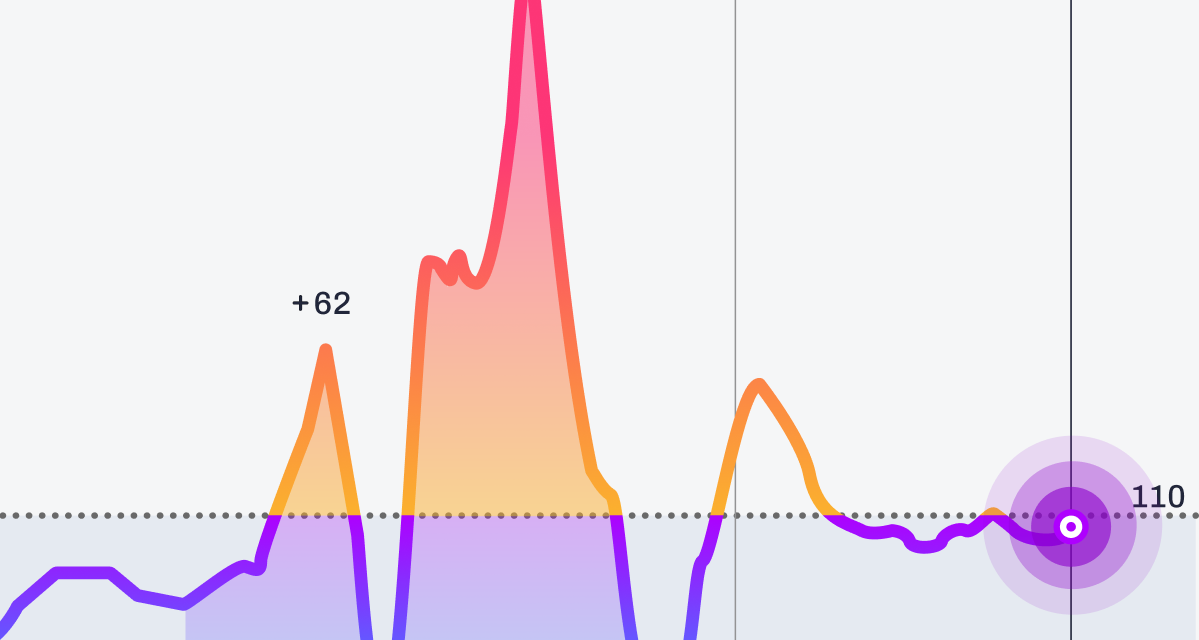
If you wear a CGM, you've likely seen what stress does to your glucose in real-time. Adrenaline and cortisol both trigger a surge of glucose into your bloodstream, and your body responds by releasing insulin to bring it back down, sometimes overshooting and dropping glucose too low. Without a CGM, you might not realize you're crashing, but you may experience the classic symptoms: intense hunger, dizziness or shakiness, trouble concentrating, fatigue, or that "wired but tired" feeling.
While your brain only accounts for about 2% of your body weight, it's the most energy-demanding organ you have, consuming 20-25% of your body's total glucose intake1 (think: ¼ of what you’re eating is fueling your brain alone). And under stress, it burns even more. A brain that’s working harder wants fast fuel, and the easiest way to get it is simple carbs.
Then it becomes a feedback loop. Sugar eases your stress response in the short-term thanks to a hit of dopamine and a bump in blood sugar, which reinforces the behavior. So when the next crash comes, it drives the next craving, which is why you're suddenly reaching for that cookie after a big presentation or in the evening after a stressful day. Often without even realizing it.
How Stress Impacts Hunger Hormones
During acute stress, your body temporarily suppresses appetite as adrenaline floods the system and shuts down digestion. This is why you may find it difficult to eat before a big presentation or during a breakup, for example.2 Cortisol takes over once the acute threat passes, with the job of replenishing what your body burned. To do that, it stimulates the hunger hormone ghrelin and blunts leptin (the hormone that tells you that you're full), often pushing people toward highly palatable (high-fat, high-sugar) foods that deliver calories quickly.
Research on emotional eating has also found something interesting about how the body's hunger signals fire.4,5 People classified as emotional eaters tend to have lower baseline ghrelin than non-emotional eaters. When stress occurs in non-emotional eaters, ghrelin spikes, but eating triggers a drop within 30-60 minutes. In emotional eaters, ghrelin stays elevated even after a meal. So the brain keeps getting the "still hungry, I need more" signal even though sufficient calories have been consumed.
This may be part of why stress cravings tend to skew sweet. Carbohydrates suppress ghrelin faster than fat or protein, but only briefly, because they also produce the sharpest rebound back to hunger5. So, sugar offers the quickest hit of relief in the moment, with the catch being that the relief doesn't last, and the cycle starts again.
7 Ways to Reclaim Control of Your Cravings
#1 Go for a walk
When the cravings strike, a brisk 15-minute walk has been shown to significantly reduce cravings for sugary snacks, even when participants were deliberately stressed and shown tempting food afterward.6 Another study found that people who walked in nature (or even just looked at nature scenes) consistently chose healthier foods afterward than those exposed to urban environments. Even seeing green spaces from your home was associated with less intense and frequent cravings.7
#2 Prioritize protein intake
Starting the day with a protein-rich breakfast reduces sweet cravings throughout the day and cuts evening snacking on high-fat, high-sugar foods.8 When cravings do hit, reaching for protein over carbs may serve you better in the long run. While carbs suppress ghrelin faster, they also cause the hormone to rebound 37% above baseline, leaving you even hungrier than before you ate.9 Protein suppresses ghrelin more gradually but there’s no rebound. So a protein-rich snack might take longer to ease the craving, but it’ll keep it from coming back.
#3 Time your sweets right
When you eat dessert matters as much as what you eat. One study had healthy women eat the same baked cake at three different times while wearing CGMs. Mid-afternoon was the best window and post-dinner was significantly worse, with bigger glucose spikes through the night and even higher glucose at breakfast the next morning.10 CGM users: try the same dessert at a few different times this week (post-lunch, mid-afternoon, post-dinner) and see which window your glucose handles best.
#4 Reach for dark chocolate
If you’re going to keep sweets in the house, stock up on dark chocolate, specifically 70% cacao or higher. Surprisingly, dark chocolate can be an effective tool for curbing sugar cravings because its richness and bitter flavor promotes satiety.11 One study found that consuming 5 ounces of dark chocolate (about one large candy bar) each week was associated with a 21% lower risk of developing diabetes.12
#5 Prioritize your sleep
Sleep plays a critical role in blood sugar levels. Even just one night of partial sleep deprivation (4 hours) induced insulin resistance in healthy individuals.13 Like stress, poor sleep also raises ghrelin and lowers leptin, increasing cravings for highly palatable foods high in refined sugar and carbohydrates.14 One study found that habitually short sleepers who extended their sleep by only 52 minutes on average ate roughly 10g less sugar per day.15 Interestingly, new research reveals that 7.32 hours (around 7 hours and 19 minutes) of sleep each night could be the sweet spot for reducing insulin resistance risk.16
#6 Chew gum
Research found that chewing gum consistently reduced hunger and specifically the desire to eat sweet snacks. In fact, people who chewed gum after lunch ate about 36 fewer calories at their afternoon snack and reported a smaller return of sweet cravings compared to those who didn’t chew gum.17
#7 Practice “urge surfing” mindfulness
Cravings tend to peak and pass within about 20-30 minutes if you don't feed them. Urge surfing is a mindfulness technique developed for addiction treatment, now widely used for food cravings.18 Instead of fighting the craving (which tends to intensify it), you observe it like a wave. Rising, cresting, then falling, without acting on it. A 2025 review found that mindfulness-based interventions were effective for managing food craving intensity (but not frequency).19
Topics discussed in this article:
References
- Mergenthaler, P., Lindauer, U., Dienel, G. A., & Meisel, A. (2013). Sugar for the brain: The role of glucose in physiological and pathological brain function. Trends in Neurosciences, 36(10), 587.
- C Yau, Y. H., & Potenza, M. N. (2013). Stress and Eating Behaviors. Minerva Endocrinologica, 38(3), 255.
- Fritz, E. M., Singewald, N., & Bundel, D. D. (2020). The Good, the Bad and the Unknown Aspects of Ghrelin in Stress Coping and Stress-Related Psychiatric Disorders. Frontiers in Synaptic Neuroscience, 12, 594484.
- Raspopow, K., Abizaid, A., Matheson, K., & Anisman, H. (2010). Psychosocial stressor effects on cortisol and ghrelin in emotional and non-emotional eaters: influence of anger and shame. Hormones and behavior, 58(4), 677–684.
- Raspopow, K., Abizaid, A., Matheson, K., & Anisman, H. (2014). Anticipation of a psychosocial stressor differentially influences ghrelin, cortisol and food intake among emotional and non-emotional eaters. Appetite, 74, 35–43.
- Ledochowski, L., Ruedl, G., Taylor, A. H., & Kopp, M. (2015). Acute Effects of Brisk Walking on Sugary Snack Cravings in Overweight People, Affect and Responses to a Manipulated Stress Situation and to a Sugary Snack Cue: A Crossover Study. PLoS ONE, 10(3), e0119278.
- Martin, L., Pahl, S., White, M. P., & May, J. (2019). Natural environments and craving: The mediating role of negative affect. Health & Place, 58, 102160.
- Leidy, H. J., Hoertel, H. A., Douglas, S. M., Higgins, K. A., & Shafer, R. S. (2015). A high-protein breakfast prevents body fat gain, through reductions in daily intake and hunger, in “Breakfast skipping” adolescents. Obesity, 23(9), 1761-1764.
- Foster-Schubert, K. E., Overduin, J., Prudom, C. E., Liu, J., Callahan, H. S., Gaylinn, B. D., Thorner, M. O., & Cummings, D. E. (2008). Acyl and Total Ghrelin Are Suppressed Strongly by Ingested Proteins, Weakly by Lipids, and Biphasically by Carbohydrates. The Journal of Clinical Endocrinology and Metabolism, 93(5), 1971.
- Nitta, A., Imai, S., Kajiyama, S., Miyawaki, T., Matsumoto, S., Ozasa, N., Kajiyama, S., Hashimoto, Y., Tanaka, M., & Fukui, M. (2019). Impact of different timing of consuming sweet snack on postprandial glucose excursions in healthy women. Diabetes & metabolism, 45(4), 369–374.
- Sørensen, L. B., & Astrup, A. (2011). Eating dark and milk chocolate: A randomized crossover study of effects on appetite and energy intake. Nutrition & Diabetes, 1(12), e21.
- Liu, B., Zong, G., Zhu, L., Hu, Y., Manson, J. E., Wang, M., Rimm, E. B., Hu, F. B., & Sun, Q. (2024). Chocolate intake and risk of type 2 diabetes: prospective cohort studies. BMJ (Clinical research ed.), 387, e078386.
- Donga, E., van Dijk, M., van Dijk, J. G., Biermasz, N. R., Lammers, G. J., van Kralingen, K. W., Corssmit, E. P., & Romijn, J. A. (2010). A single night of partial sleep deprivation induces insulin resistance in multiple metabolic pathways in healthy subjects. The Journal of clinical endocrinology and metabolism, 95(6), 2963–2968.
- Cauter, E. V., Spiegel, K., Tasali, E., & Leproult, R. (2008). Metabolic consequences of sleep and sleep loss. Sleep Medicine, 9(0 1), S23.
- Al Khatib, H. K., Hall, W. L., Creedon, A., Ooi, E., Masri, T., McGowan, L., Harding, S. V., Darzi, J., & Pot, G. K. (2018). Sleep extension is a feasible lifestyle intervention in free-living adults who are habitually short sleepers: a potential strategy for decreasing intake of free sugars? A randomized controlled pilot study. The American journal of clinical nutrition, 107(1), 43–53.
- Fan Z, Wei R, Chen T, Yan X, Yin S, Cao Y, et al. Association of weekday sleep duration and estimated glucose disposal rate: the role of weekend catch-up sleep. BMJ Open Diabetes Research & Care. 2026;14:e005692.
- Hoevel, C. J. T., Llauradó, E., Valls, R. M., Besora-Moreno, M., Queral, J., Solà, R., & Pedret, A. (2025). Effects of Chewing Gum on Satiety, Appetite Regulation, Energy Intake, and Weight Loss: A Systematic Review. Nutrients, 17(3), 435.
- Bowen, S., & Marlatt, A. (2009). Surfing the urge: brief mindfulness-based intervention for college student smokers. Psychology of addictive behaviors : journal of the Society of Psychologists in Addictive Behaviors, 23(4), 666–671.
- Allameh, S.A., Mokhtari, Z., Hosseini, E. et al. Effects of mindfulness-based interventions on food craving in adults: a systematic review and meta-analysis of controlled clinical trials. BMC Psychol 13, 1022 (2025).

.svg)

.jpeg)