

Here's a number that might stop you in your tracks: nearly 1 in 3 American adults has pre-diabetes, and close to 80% of them have no idea.
Not because they're not paying attention, but because pre-diabetes doesn't always show up clearly on a standard lab panel. Your fasting blood glucose and A1c can come back looking "normal" while your body is quietly giving you signals that something's off.
The thing is, your body often starts communicating these changes long before any lab result crosses a diagnostic threshold. You just have to know what you're looking for.
Below, we get into the 5 signs that are often missed or explained away as something else entirely.
Sign #1: You Crash Hard After Eating
You eat what seems like a solid lunch, and within an hour, you're exhausted. Your mind feels foggy, and you can't focus. You reach for coffee or something sweet just to make it through the afternoon, and at this point, that's less of a choice and more of a survival move.
What's actually happening: After you eat, your blood sugar rises (completely normal). But when your meal is higher in refined carbs, it can rise too quickly. Your body releases insulin to bring it back down, and sometimes overcorrects, which sends blood sugar dropping just as fast as it rose. Researchers call this reactive hypoglycemia, and it's increasingly recognized as more than just an inconvenience.
A 2023 review published in Metabolism: Clinical and Experimental found that reactive hypoglycemia is likely an early marker of impaired beta-cell function and reduced insulin sensitivity. In other words, a signal that your body's glucose regulation is already under strain. The same research used fMRI (brain) imaging to show that even mild post-meal glucose drops activate the brain's reward centers, producing a greater desire for high-calorie foods. So that afternoon craving isn't a lack of discipline, it’s a neurological response to your body’s blood sugar signal.
Why it matters: Research published in IntechOpen classifies reactive hypoglycemia as a potential early indicator of impaired glucose tolerance and notes that elevated insulin secretion can start creeping up 3-4 years before a diabetes diagnosis as a response to growing insulin resistance. Frequent energy crashes may be one of the earliest recognizable signs of that process.
When your energy feels like a rollercoaster throughout the day, your blood sugar often is too.
Sign #2: You Wake Up Between 2-4am
You're not particularly stressed. There's no obvious reason for it. But you find yourself waking up in the middle of the night, sometimes feeling hot or restless, and even after a full night in bed, you're still exhausted the next morning.
What's actually happening: While you sleep, your body is actively working to maintain glucose stability. If blood sugar dips too low overnight, your body triggers stress hormones (adrenaline and cortisol) to bring levels back up.
Why it matters: The sleep disruption itself compounds the problem. A landmark study in the Journal of Clinical Endocrinology & Metabolism (Donga et al., 2010) found that just one night of partial sleep deprivation reduced insulin sensitivity by approximately 25% in healthy subjects the very next day.
And research published in the Journal of Applied Physiology showed that recurring partial sleep restriction decreases glucose tolerance and simultaneously lowers leptin (your satiety hormone) while raising ghrelin (your hunger hormone), setting off a cascade that makes blood sugar harder to regulate and cravings harder to resist, day after day.
It's not just your sleep that's off. It may be the system regulating your energy while you're in it.
Sign #3: You're Doing Everything Right and Still Not Losing Weight
You're eating well and moving your body, but the scale won't budge. Or worse, you're gaining weight more easily than you used to, especially around your midsection. You hit plateaus that don't match your effort. Something feels off, but you can't point to what.
What's actually happening: Skeletal muscle accounts for up to 70% of the body's glucose disposal, according to research published in the NIH Bookshelf on insulin resistance. When muscle cells begin to resist insulin's signal, excess glucose gets shunted to your liver, where it's converted to fat (particularly in and around your abdomen).
This is known as visceral fat (deep abdominal fat that sits in and around your organs), which acts more like a hormone-secreting organ in a way that subcutaneous fat (surface level fat right beneath your skin) does not. It secretes inflammatory cytokines, worsens insulin resistance further, and makes fat burning progressively harder.
A landmark study published in JAMA (Neeland et al., 2012) tracking 732 adults over 7 years found that excess visceral fat mass (not BMI or how much general fat mass someone has) was the primary independent predictor of pre-diabetes and type 2 diabetes. Each standard deviation increase in visceral fat was associated with a 2.4x higher odds of developing diabetes. Importantly, the study found no significant association with total body fat or subcutaneous fat. This means, it’s where the fat is that matters, not just the how much.
Why it matters: If your effort and results aren't matching up, it may be worth looking deeper at how your body is processing energy. Not just how hard you're working.
Sign #4: You Feel Shaky, Anxious, or "Hangry" When Your Meals Are Delayed
Hunger for you doesn't come on gradually. It comes on suddenly and urgently. If you miss a meal or push it back, you feel irritable, shaky, or anxious. Almost like a switch gets flipped. Strong cravings for sugar or carbs hit, especially later in the day, and your mood can shift quickly depending on when or what you eat.
What's actually happening: When blood sugar drops quickly, the body activates its stress response (adrenaline and cortisol) which creates the shakiness, irritability, and anxiety you feel. At the same time, your brain is pushing you quickly towards fast-absorbing carbohydrates to restore glucose levels quickly.
This pattern reflects what researchers call impaired metabolic flexibility, the body's reduced ability to maintain stable energy between meals by efficiently switching between fuel sources (eg, carbs for fuel vs. fat for fuel). Research classifies this late-onset reactive hypoglycemia pattern (4-5 hours post-meal) as being associated with insulin resistance and describes it as an early indicator of impaired glucose tolerance and type 2 diabetes (IntechOpen, 2025). This pattern is also more prevalent in women with PCOS (Nutrition & Metabolism, 2018).
Why it matters: This isn't just "being hungry." It's a reactive signal from a body struggling with energy regulation. The more frequently it happens, the more it reinforces the underlying instability driving it.
Sign #5: Your Labs Are "Normal," But You Don't Feel Normal
Your doctor says everything looks fine, but you don't feel like yourself. Your energy is off, your sleep isn't great, your hunger feels unpredictable. And you have this nagging sense that something has shifted, even if you can't point to a specific number.
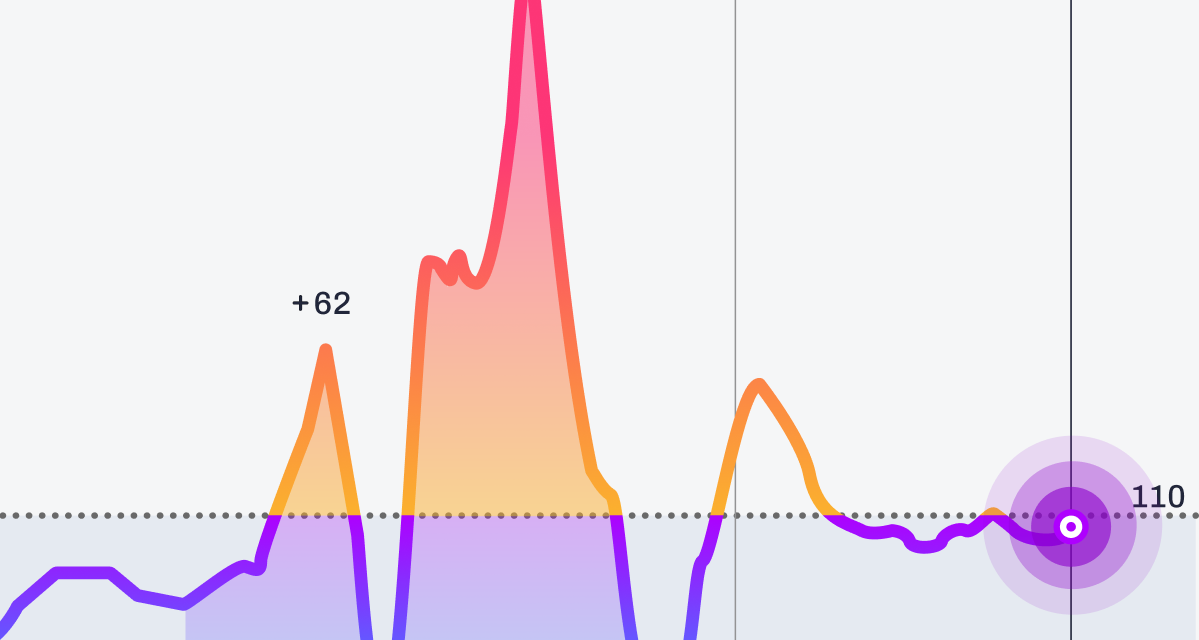
What's actually happening: Standard markers like fasting blood glucose and A1c are single point in time measurements. They tell you very little about what your blood sugar is doing throughout the day (eg, the spikes, the variability, the post meal patterns) that can be happening long before any number gets flagged.
Research in Metabolism: Clinical and Experimental found that CGM use in healthy, non-diabetic individuals revealed glucose patterns that entered the diabetic range in 15% of people (and 36% of those with pre-diabetes) despite many having "normal" standard lab results. Even more telling: among participants, 91.7% showed measurable improvement after just 10 days of using a CGM with behavioral feedback.
Other subtle signals worth paying attention to include glucose trending higher over time (even within "normal" range), changes in triglycerides or HDL, skin tags or darkened skin patches (especially around your neck or armpits), and for women, hormonal shifts like irregular cycles or worsening PMS.
Why it matters: According to the CDC, nearly 98 million American adults (that’s more than 1 in 3) have pre-diabetes, and nearly 80% don't know it. Waiting for a lab to flag something can mean missing the window where changes are most reversible. "Normal" doesn't mean optimal, especially when your body is already giving you data in how it feels.
What You Can Do Starting Now
You don't need a diagnosis to start paying attention. Your body is giving you meaningful information every single day.
Start noticing your patterns.
- When do your energy crashes tend to hit and what did you eat beforehand?
- Which meals leave you feeling steady vs. foggy an hour later?
- When does your hunger feel manageable vs. urgent and reactive?
- How is your sleep, and does it seem connected to what you ate the night before?
Build meals that support stable energy.
- Lead with protein before your carbs at every meal (research consistently shows eating protein first blunts the post-meal glucose spike)
- Pair carbohydrates with fat or fiber to slow absorption
- Create more consistency with when and how often you eat
- Reduce long gaps followed by large meals or late night snacking
Support the full picture. Your blood sugar is shaped by more than food. Sleep, stress, daily movement, and routine all play a measurable role. Small, consistent improvements in any of these areas can meaningfully shift how your body regulates energy over time.
And if you want real visibility into what's actually happening (not just a snapshot, but your patterns across the day), a continuous glucose monitor (CGM) can be an illuminating tool to add to your toolkit. Especially when insights from standard lab work feel murky or inconclusive.
The Takeaway
Pre-diabetes doesn't start in a lab. It starts in your daily patterns: in how your energy behaves after meals, how your sleep holds up, how your body responds to stress, and how your hunger feels throughout the day.
Your body is giving you information. You don't have to wait for your doctor to flag it first.
The earlier you start paying attention, the more options you have. And awareness, it turns out, is where everything starts.
Topics discussed in this article:
References

.svg)