

Imagine losing 15 pounds. Everyone congratulates you. The scale says you're making incredible progress.
But here's the question almost nobody asks: what did you actually lose? Fat? Muscle? Water weight? Some mix of all three?
Losing weight isn't automatically the same thing as getting healthier. If the scale is the only number you're tracking, you're only seeing part of the picture, the part that adds up your bones, organs, water, muscle, and fat into one total and calls it "progress."
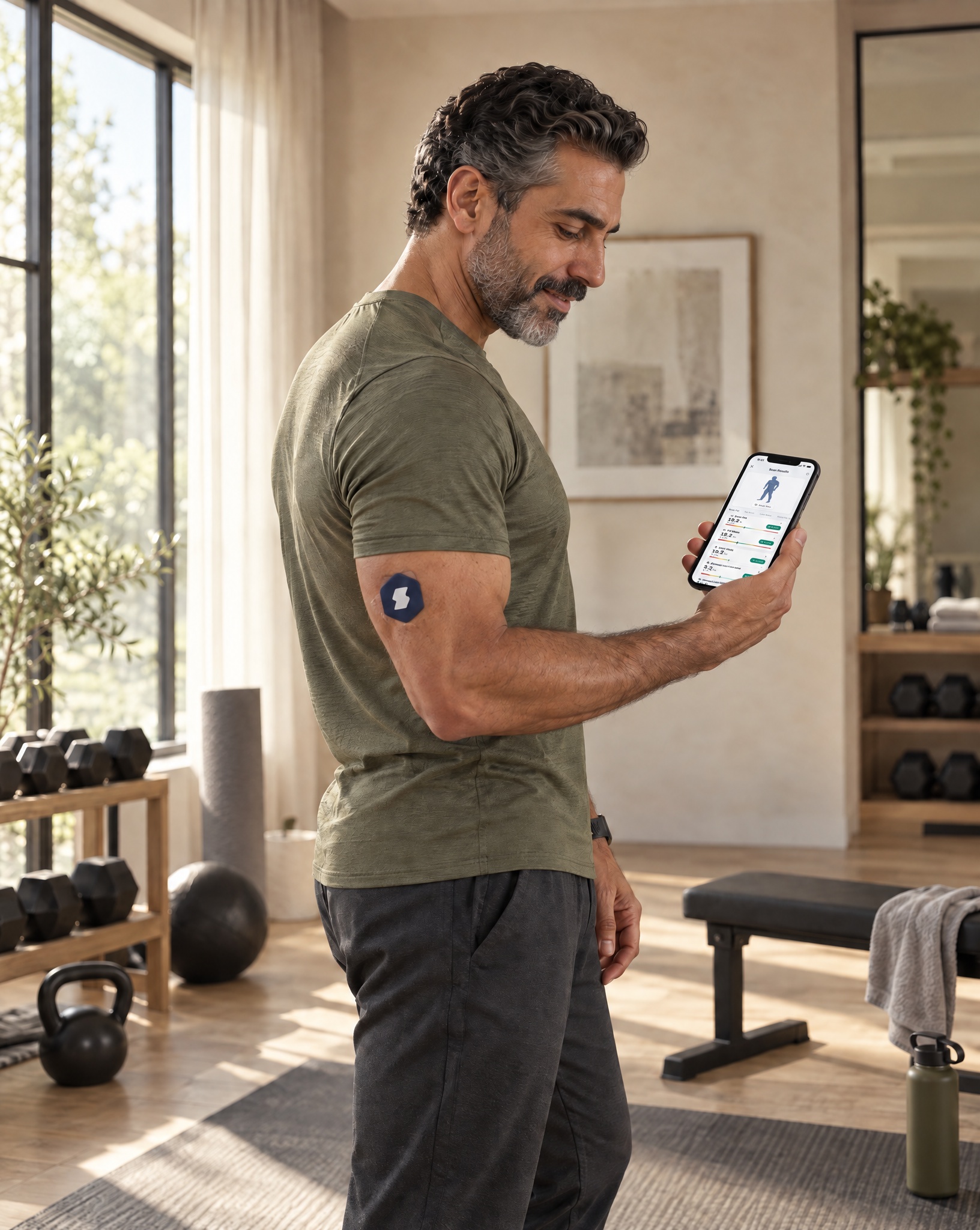
That's why body composition has become one of the most important tools in modern weight management, and why we're introducing Body Scanning inside the Signos app: a way to see (using nothing but your phone) whether you're losing fat or muscle, where fat is being stored or lost, how your body shape is changing over time, and what those changes mean for your health.
Body Composition vs. Weight: What the Scale Can't Tell You
Your weight is really several different things stacked together: fat, muscle, organs, water, bone, stored energy. The scale adds it all up into one number. A pound of fat lost and a pound of muscle lost look identical there, but they are not remotely the same event inside your body.
In one of the largest studies on the subject, the Multi-Ethnic Study of Atherosclerosis tracked visceral fat (the fat surrounding your organs, distinct from the fat under your skin) using repeated imaging over time. People with more visceral fat had higher rates of metabolic syndrome and heart disease regardless of their BMI, while subcutaneous fat (the fat just under the skin) wasn't associated with the same risk once visceral fat was accounted for.¹. Two people can share the same BMI but carry very different levels of risk, because BMI has no way of knowing where your fat actually lives or how much muscle mass you may have.
Muscle tells a similarly important story. A 2023 meta-analysis of 16 studies and over 81,000 adults found that people with low skeletal muscle mass had a meaningfully higher risk of dying from any cause, and this held true across all age groups, not just in older adults.². Body composition, not the number on the scale, is what's actually driving these outcomes. That's the gap Body Scanning closes.
What Is Body Composition and Why Does It Matter?
Here's what your Body Scan measures, and why each piece matters:
Body fat percentage is the share of your weight that's fat tissue compared to the rest of your body, as opposed to muscle, bone, organs, and water. Fat isn't just stored energy; it acts like an active organ, producing hormones that influence hunger, inflammation, and insulin sensitivity.
Lean mass is everything that isn't fat: muscle, bone, organs, water. More lean mass generally means more metabolically active tissue working on your behalf around the clock. Less, especially through muscle loss, means a smaller engine.
Skeletal lean mass is the muscle attached to your bones, the tissue you use to walk, lift, and move. It's also one of your body's primary sites for clearing glucose from your bloodstream after meals, which is part of why muscle and blood sugar stability are so closely linked.
Appendicular lean mass includes the muscle that is in your arms and legs.
Visceral fat is the fat surrounding your organs rather than sitting under your skin, and, as covered above, a stronger signal of cardiometabolic risk than total weight alone¹.
Waist-to-hip ratio reflects where your body tends to store fat, a useful proxy for visceral fat patterns without needing imaging. This is one of the strongest measurements of your future predicted health outcomes, yet often overlooked.
Why Body Composition Matters During Weight Loss
When you lose weight quickly, whether through diet changes, activity, or a GLP-1 medication, your body doesn't only pull from fat stores. Some of what you lose can be muscle.
That matters more than it might seem. Less muscle means a lower resting metabolic rate, since muscle is metabolically active tissue that burns energy even at rest, which can make long-term weight maintenance harder, not easier. Less muscle can also mean less strength and mobility over time.
This is exactly why muscle preservation has become such a major conversation in GLP-1 research, and part of why Signos+ pairs a GLP-1 with a continuous glucose monitor and dietitian support rather than treating the medication as a solution on its own. A GLP-1 can quiet food noise and create real momentum. It can't tell you, on its own, whether the weight coming off is the weight you actually want to lose.
Meet Body Scanning
Using only your smartphone, guided through a short 360° spin right inside the Signos app, you can now generate:
- Body fat percentage
- Fat mass
- Lean mass (which includes skeletal and appendicular)
- Visceral fat
- Waist-to-hip ratio
- Measurements of the chest, waist, hip
- Body roundness score
- Predicted BMI
- An interactive 3D avatar of your own body
No appointment, no specialized equipment, no undressing beyond form-fitting workout clothes. Open your Log, tap "+ Body scan," follow the guided spin, and a couple of minutes later your results sit alongside your weight and glucose data.
The 3D avatar solves a real, specific frustration: the weeks where the scale barely moves even though your body is clearly changing shape. That's body recomposition, losing fat while maintaining or building muscle, and it's invisible to a scale by definition. Your avatar and your composition numbers make it visible.
How Body Composition and CGM Data Work Together
Your CGM answers a question about right now: how did that meal, that walk, that stressful morning affect your glucose today? Your Body Scan answers a slower question: how has your body actually changed over these past few weeks or months?
Together, they trace a single chain:
Behavior → blood sugar → body composition → weight → metabolic health
Your daily choices show up first in your glucose graph. Over time, those same patterns show up in your body composition, and eventually on the scale, but by then you've had weeks of earlier signal you could have acted on. Body Scanning doesn't compete with your glucose data. It completes it.
Why Body Composition Matters When You're Taking a GLP-1
If you're using a GLP-1, whether through Signos+ or elsewhere, this is where Body Scanning does some of its most important work.
Rapid weight loss on a GLP-1 can come with rapid lean mass loss. In the SURMOUNT-1 DEXA substudy, published in 2025, researchers scanned participants taking tirzepatide before and after 72 weeks of treatment and found that roughly a quarter of the weight they lost was lean mass, not fat³. That's not unique to one drug; it's a predictable pattern with rapid weight loss on any GLP-1, and it's exactly the kind of change your scale can't flag, since a pound of muscle and a pound of fat weigh the same. Body Scanning lets you monitor the quality of your weight loss, not just the quantity.
This also matters for what happens after a GLP-1. A systematic review published in the BMJ found that people who stop taking semaglutide or tirzepatide tend to return to their baseline weight within 12 to 18 months, regaining weight at roughly twice the rate they lost it⁴,⁵. If the weight that returns is disproportionately fat while what was lost included muscle, someone can end up in a worse metabolic position than where they started, even at an identical weight on the scale.
That's the case for pairing a GLP-1 with a CGM, dietitian support, and now Body Scanning: the medication reduces food noise, the CGM shows how your body responds to food in real time, and Body Scanning shows whether the plan is protecting the muscle you have while the fat comes off. That's what makes results more likely to last beyond the prescription.
How to Track Body Composition Changes Accurately
A single scan is a snapshot. The trend is what's useful:
- Scan under consistent conditions. Time of day, hydration, and recent meals can all shift your readings slightly. Scanning first thing in the morning, before eating, means the change between scans reflects something real.
- Watch the trend, not the single scan. Since roughly a quarter of GLP-1-driven weight loss can come from lean mass³, scanning regularly enough to catch a downward trend early gives you time to act, before months have passed.
- Pair a declining lean-mass trend with protein and resistance training. Research on muscle protein synthesis has found that 20 grams of high-quality protein in a single sitting is enough to maximize the muscle-building response your body can use at once⁶, and eating that protein before carbohydrates has been shown to meaningfully blunt the glucose and insulin spike from the same meal⁷. Add even brief resistance training and you're working directly against the mechanism causing the loss.
- Read your scan alongside your glucose data. A week of more volatile glucose than usual is exactly the week to check whether your body composition is shifting too.
Can a Body Composition Scan Replace a DEXA Scan?
DEXA scanning remains an excellent clinical-grade tool, and if your doctor needs precise diagnostic data, it's still the right choice. But most people aren't getting a DEXA scan every month, and that's the gap Body Scanning fills.
A single DEXA scan typically runs $40 to $200 at a wellness provider, and $150 to $400 or more at a hospital or imaging center, almost always out of pocket since insurers treat body composition scanning as elective. Add in finding a provider and booking an appointment, and most people get scanned once, if ever, which makes it nearly impossible to track a trend.
Body Scanning gives you that same category of information in your pocket, on your own schedule. It isn't trying to replace a clinical DEXA scan. It's solving the more common problem: most people were never going to get scanned regularly in the first place, and now they can.
How Body Composition Tracking Can Improve Weight Loss Decisions
Weight tells you how much your body has changed. Body composition tells you what actually changed.
Bring these signals together:
CGM → body composition → weight → nutrition → movement → GLP-1 support (when appropriate)
and you get a far richer understanding of your metabolic health than any single number could offer.
Lasting progress was never really about watching a scale move. It's about understanding the story underneath it, and now, that story is something you can actually see.
Open your Log and tap "+ Body scan" to see what your own body composition looks like. And if you're new to Signos and wondering what a smarter, more complete way to approach weight loss (with or without a GLP-1) could look like for you, this is a good place to start.
Topics discussed in this article:
References
- Shah, R. V., Murthy, V. L., Abbasi, S. A., et al. (2014). Visceral Adiposity and the Risk of Metabolic Syndrome Across Body Mass Index: The MESA Study. JACC: Cardiovascular Imaging, 7(12), 1221-1235. https://doi.org/10.1016/j.jcmg.2014.07.017
- Wang, Y., Luo, D., Liu, J., Song, Y., Jiang, B., Jiang, H. (2023). Low skeletal muscle mass index and all-cause mortality risk in adults: A systematic review and meta-analysis of prospective cohort studies. PLOS ONE, 18(6), e0286745. https://doi.org/10.1371/journal.pone.0286745
- Look, M., Dunn, J. P., Kushner, R. F., et al. (2025). Body composition changes during weight reduction with tirzepatide in the SURMOUNT-1 study of adults with obesity or overweight. Diabetes, Obesity and Metabolism, 27(5), 2720–2729. https://doi.org/10.1111/dom.16275
- Wilding, J. P. H., Batterham, R. L., Davies, M., et al. (2022). Weight regain and cardiometabolic effects after withdrawal of semaglutide: The STEP 1 trial extension. Diabetes, Obesity and Metabolism, 24(8), 1553–1564. https://doi.org/10.1111/dom.14725
- West, S., Scragg, J., Aveyard, P., et al. (2026). Weight regain after cessation of medication for weight management: Systematic review and meta-analysis. BMJ, 392, e085304. https://doi.org/10.1136/bmj-2025-085304
- Moore, D. R., Robinson, M. J., Fry, J. L., Tang, J. E., Glover, E. I., Wilkinson, S. B., Prior, T., Tarnopolsky, M. A., Phillips, S. M. (2009). Ingested protein dose response of muscle and albumin protein synthesis after resistance exercise in young men. American Journal of Clinical Nutrition, 89(1), 161-168. https://doi.org/10.3945/ajcn.2008.26401
- Shukla, A. P., Iliescu, R. G., Thomas, C. E., Aronne, L. J. (2015). Food Order Has a Significant Impact on Postprandial Glucose and Insulin Levels. Diabetes Care, 38(7), e98-e99. https://doi.org/10.2337/dc15-0429

.svg)