

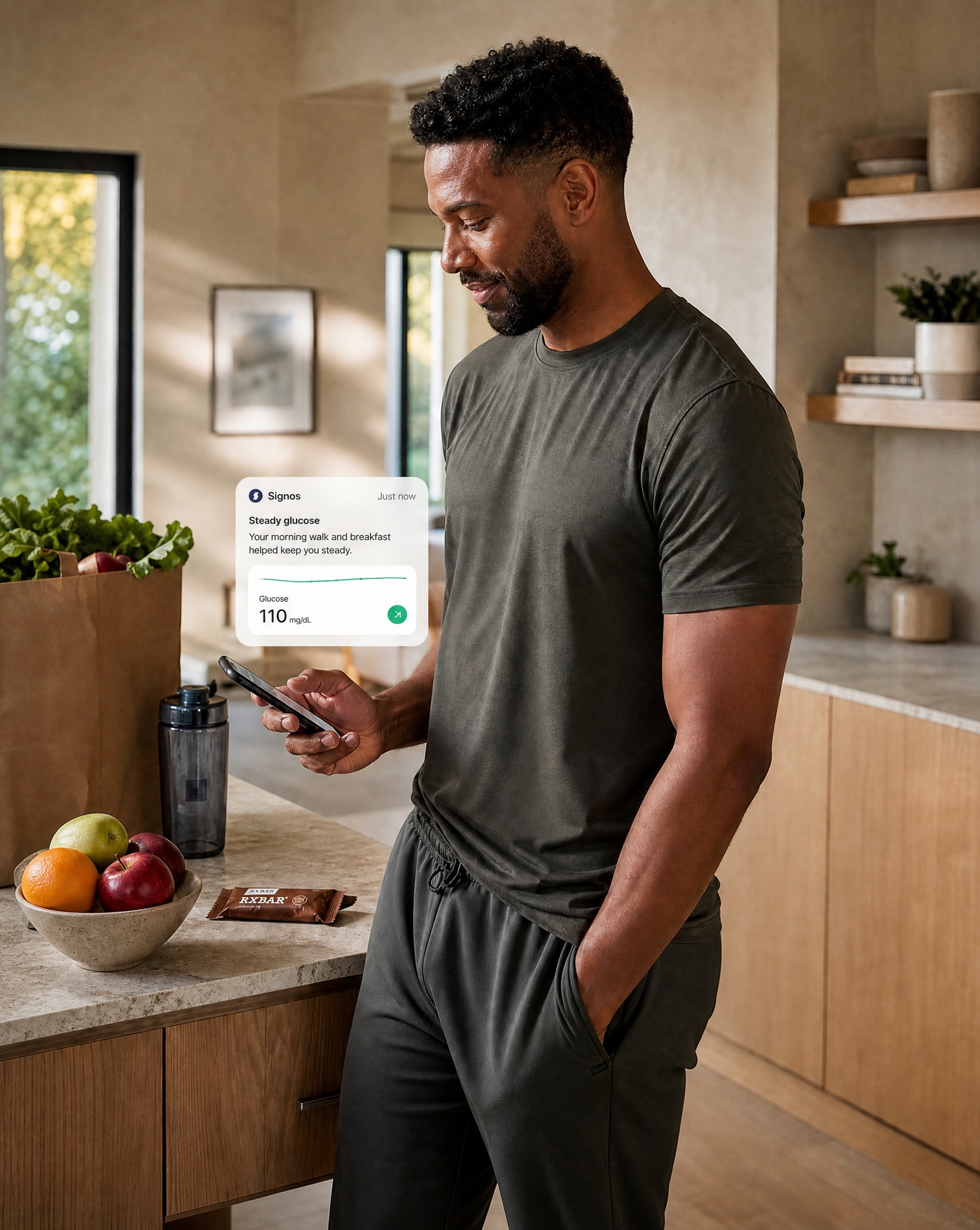
Weight loss has more tools available than ever. Medications that quiet appetite. Wearables that track thousands of data points. Apps that log every calorie, step, and hour of sleep.
And yet, having more data has never automatically translated into knowing what to do with it.
At Signos, we wanted to explore a different question: what happens when people can see how their own body is responding and receive personalized support that helps them act on that information in real time? That's what a new peer-reviewed study set out to investigate.
What the New Signos Weight Loss Study Found
Published in Diabetes Technology & Therapeutics, the study analyzed real-world data from 3,007 adults with obesity (BMI 30 or higher), without diabetes, and not taking GLP-1 medications.1
Researchers examined two things: what happened to the same person's weight loss rate during engaged versus non-engaged periods, and whether higher overall engagement over six months was linked to better outcomes.
The headline findings.
Average total body weight loss:
- At six months: 5.14%
- For higher-engaged participants: 5.9%
- For highly engaged participants with Class III obesity (BMI 40+): 7.09%
- During engaged periods: nearly 3x faster than non-engaged periods
This was a retrospective observational study. The findings show an association between engagement and weight loss, not a direct causal link. But the consistency across all obesity classes, age groups, and sexes makes it a meaningful signal.
Why Signos Users Lost Weight Nearly 3X Faster During Engaged Periods
Participants lost 1.17% of body weight per week during engaged periods, compared with 0.44% per week when not engaging. Critically, these were compared within the same individuals, not between more versus less motivated people.
Engagement wasn't passively wearing a CGM or opening an app. It meant intentional actions: logging meals, logging exercise, logging weight, responding to AI-generated insights, completing educational content, and interacting with glucose data.
Owning health data and actively engaging with it are not the same thing. Someone can wear a glucose monitor without understanding their patterns. The value of personal health data depends significantly on whether someone has the tools to understand it, act on it, and adjust in real time.
How a CGM and AI Can Turn Personalized Health Data Into Action
Most health tracking is retrospective. You see yesterday's calories, last week's activity, last month's weight trend, then try to guess what to change.
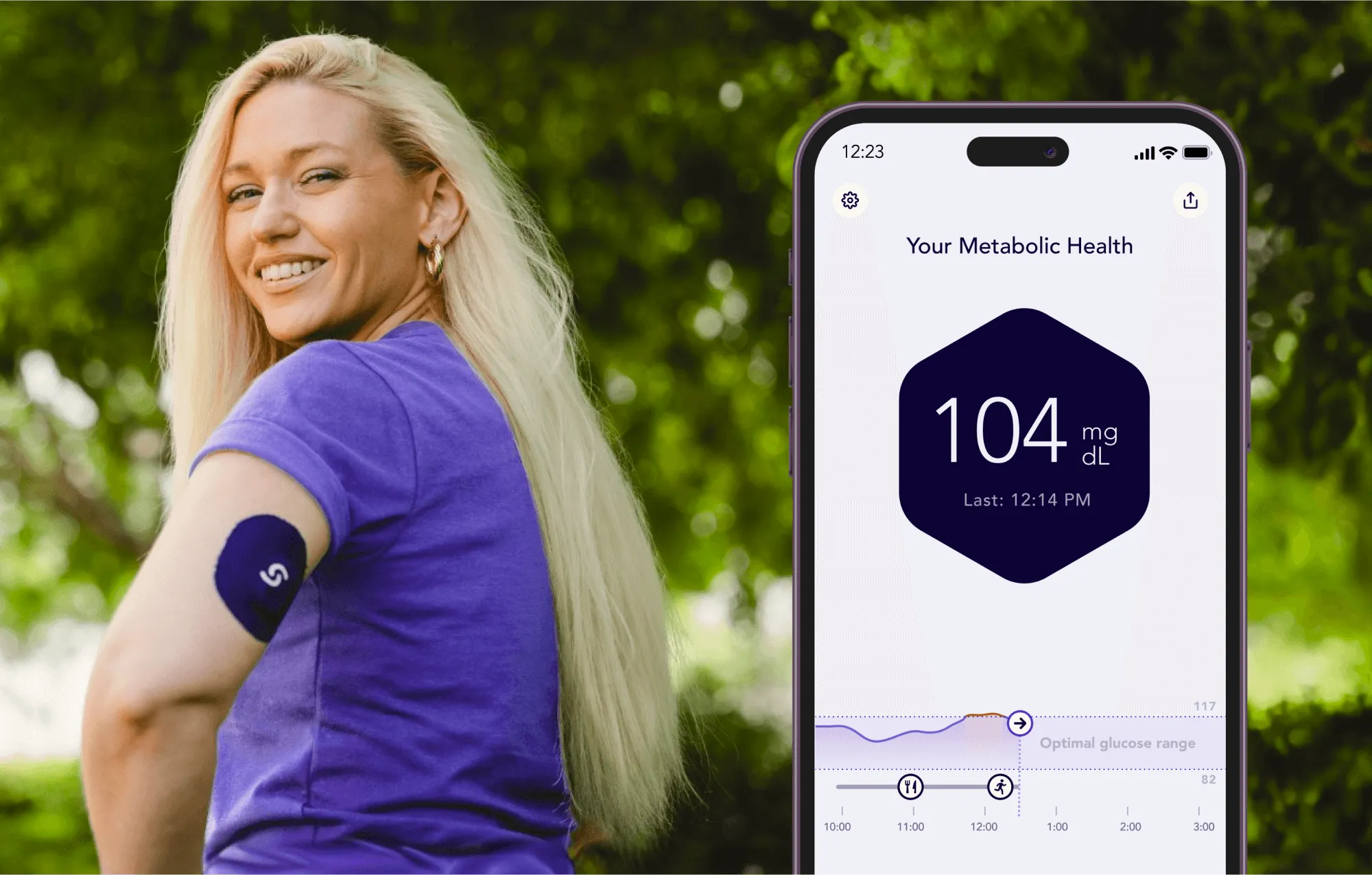
The Signos model works differently. The system integrates CGM glucose data with food intake, physical activity, sleep, heart rate, and weight. AI and machine-learning identify individual metabolic patterns and deliver personalized recommendations in near real time.
Instead of: Eat → Track → Wait → Weigh → Guess what worked
The loop becomes: Act → See your response → Learn → Adjust → Test again
The core differentiators include shorter feedback loops (no waiting weeks for the scale to confirm whether something is working), personal relevance (guidance from your own patterns, not generalized advice), and reinforcement (seeing a favorable response makes a new behavior easier to repeat).
Higher Engagement Was Linked to Greater Weight Loss and Healthier Behaviors
For someone starting at 200 pounds, 5% weight loss is 10 pounds. 7% is 14 pounds. Those numbers may sound modest, but the health changes that follow are anything but. A 5% reduction in total body weight is widely recognized as the clinical threshold at which meaningful improvements begin to appear across blood pressure, insulin sensitivity (how efficiently the body clears glucose from the bloodstream), triglycerides, HDL cholesterol, and cardiometabolic risk. An average weight loss of 5.5% was associated with a 58% reduction in diabetes incidence in the Diabetes Prevention Program trial.2 Because BMI changes proportionally with body weight when height remains constant, losing 5% of body weight also reduces BMI by approximately 5%. Even modest weight loss is associated with meaningful improvements in cardiometabolic risk factors across populations.3
Higher-engagement participants also averaged 165 minutes of exercise per week versus 131 minutes, and 10.5 meal logs per week versus 2.4. The story isn't simply that using an app produces more weight loss. The more interesting possibility is that engagement with personalized feedback helps people turn information into repeated behaviors, which is often the harder part.
Why It's Never Too Late to Re-Engage With Your Weight Loss Goals
If you've ever had a bad week, skipped logging for a month, been away on vacation, had a busy season of life, or otherwise stepped away from your routine entirely and thought "I've blown it," this finding is for you.
Weight loss rates during engaged periods were similar whether engagement happened early or late in the program. Early engagers lost 1.18% per week. Late engagers lost 1.12% per week. No statistically significant difference. Most digital health research points to early engagement as the primary predictor of success, making this one of the more surprising and clinically meaningful findings in the study. The same rate of progress was available to people who returned later as to those who never fell off.
Re-engaging still matters. Coming back still works.
What This Study Adds to the Conversation About CGM, GLP-1s, and Weight Loss
Participants in the Signos six-month cohort achieved average weight loss on par with what similar real-world GLP-1 studies report over 12 months. That comparison is worth noting, but context matters.
This was not a head-to-head clinical trial. Large randomized trials of GLP-1 medications have demonstrated substantially greater absolute weight loss over longer periods. What the comparison does reinforce is that meaningful weight loss can happen through more than one pathway, and obesity care needs more than one solution.
For some people, a CGM-informed behavioral approach may be an effective primary strategy. For others, GLP-1 medications are powerful tools that act on appetite, satiety, and biological pathways involved in weight regulation. And for some, combining both may be the most comprehensive approach: medication addresses the biology, while real-time data builds the habits that hold when the prescription ends. That's the thinking behind Signos+.
What This Research Could Mean for the Future of Personalized Weight Loss
This study doesn't answer every question. Because it was retrospective and observational, prospective research will be important for understanding causality and long-term outcomes. But it adds meaningful evidence to the conversation: active engagement with personalized, real-time metabolic feedback was associated with clinically meaningful weight loss, consistently, across diverse populations.
The next era of weight management may be less about finding the right universal plan, and more about helping each person understand what their own body is actually doing.
Topics discussed in this article:
References
- Dixon, W., Kim, S., Shryack, G. E., Levonian, D., Gusz, D., Fouladgar-Mercer, S., & Skyler, J. S. (2026). Engagement with an AI- and CGM-Integrated Digital Health Platform Is Associated with Clinically Significant Weight Loss. Diabetes Technology & Therapeutics. DOI: 10.1177/15209156261459741
- Williamson, D. A., Bray, G. A., & Ryan, D. H. (2015). Is 5% weight loss a satisfactory criterion to define clinically significant weight loss? Obesity, 23(12), 2319–2320. DOI: 10.1002/oby.21358
- Elmaleh-Sachs, A., Schwartz, J. L., Bramante, C. T., Nicklas, J. M., Gudzune, K. A., & Jay, M. (2023). Obesity Management in Adults: A Review. JAMA, 330(20), 2000–2015. DOI: 10.1001/jama.2023.19897

.svg)





.png)
.jpg)